Showing posts with label performance practice. Show all posts

Sunday, August 28, 2016

il diavolo è nei dettagli (the devil is in the details) ...


It seems only appropriate to title this post in Italian, as Italians do indeed use the phrase listed above. 

I’m hard-at-work these days, keeping my main wheel going (tenure-track position at a University), along with addressing different “spokes” of this wheel. I’m preparing the chorus (for my first time) of Opera Southwest’s production of Tancredi (you can purhcase tickets here).

The task ahead of us as a team is to prepare a little-known masterpiece of Rossini for four performances in late October. Within the preparation process, and really the most fun part, is working on details.

For example, there are plenty of dynamic markings in parenthesis in the score.

[f

Which usually means that an important, past edition has the markings, but the current editor isn’t sure 100% if the dynamics or instructions are accurate enough. 

I am so proud of the work we are doing together.  

For a fun web-link which refers to the title above, click here.
PHOTO: A bird's-eye view of rehearsal this past Saturday. Photo credit - Ryan Guth

Thursday, March 10, 2016

Magnificat


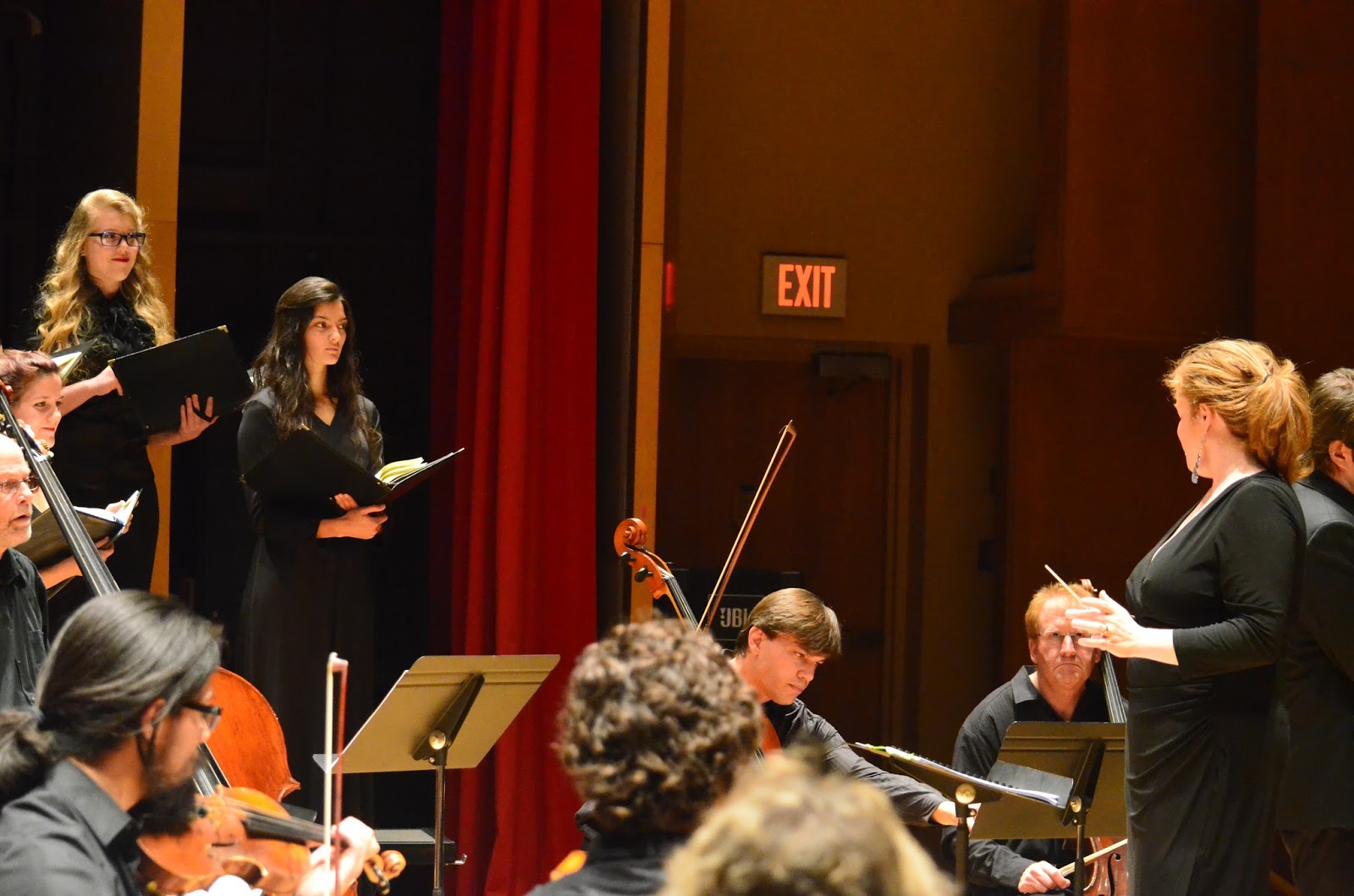
This past Sunday, I got to make music in a way that I really "believed.” During the course of times that have been far too crammed, this came (strangely) as a huge blessing and gift.   

I have known the Bach Magnificat perhaps since undergraduate, when I played some of the solo arias in lessons for friends and colleagues. 
At Westminster Choir College, Dr. Andrew Megill led the Westminster Kantorei in a rehearsal and performance process that was life-changing.

Several other performances have followed.

When I was asked to take over (some) choral duties at UNM for this academic year, I bartered for the top auditioned choir. This year has been an amazing journey for me with them, as I have learned some things as a choral conductor “from scratch” (warm-ups, administration). Other things I feel have been a very natural extension of me (rehearsing a cappella, further development of ears, honing in on rhythm, controlling more lines of polyphony, further work on musicianship). 

The only thing I REALLY wanted to do, all year, was this piece. 
Thirty minutes of unadulterated joy. It’s also one of the most perfect pieces of music ever written. It’s the best of Bach (and that is saying a *lot*). Imagine my surprise when my colleagues delightedly volunteered to play in the orchestra. They were able to recommend graduate students to fill out the ranks.

One of my best students (a good undergraduate singer) said,

“The thirty minutes we shared on stage might be one of the best memories of my life. Doing anything."

Thank you.

As Bach said, "Soli Dei Gloria." 


Friday, December 18, 2015

The Force of J.S. Bach


We have a big concert (and two big concerti) tomorrow night! It’s the third annual “Bach by Candlelight.” Click here to purchase tickets. 


PHOTO: A Go-Pro photo of Bach practicing, Concerto in d minor, BWV 1052. Come on Saturday to hear it! 
 
Here is a video link to something I made. Click on this ...  See if you get the joke - you have to watch until the end of the video - 

And here is a quote by Glenn Gould that perfectly sums up why I / we do this concert every year, and my feelings on Bach’s music in particular …. 
 
"I think that if I were required to spend the rest of my life on a desert island, and to listen to or play the music of any one composer during all that time, that composer would almost certainly be Bach. 

"I really can’t think of any other music which is so all-encompassing, which moves me so deeply and so consistently, and which, to use a rather imprecise word, is valuable beyond all of its skill and brilliance for something more meaningful than that — its humanity."

Saturday, December 12, 2015

Bird's-Eye Bach

I’ve been enjoying the downtime and practicing Bach a lot. And I’m taking a page from this artist and have been filming my practicing. I’ve been noticing two things, which are small technicall break-throughs for me ...

1. I have to have contact with key before I release it downward. For years, I’ve been probably using a lot of (mini) "blind-landings” from fingertip to key. Something in my harpsichord practice yesterday really “klicked.” 

2. The videos have also identified small micro-bursts of energy that don’t go with the music. These are the “I don’t believe yous” that I am trying to help my students identify in themselves. I’m a firm believer in “teachers should not ask something of others that they cannot do themselves.” 


PHOTO: A bird's-eye view of Bach practicing. 

I’m grateful for this breathing time, and this time to be my own teacher.

Thursday, February 12, 2015

What's all the "Chatter" about?

Yesterday was an important “debut” for me in Albuquerque. There is a unique, 50-weeks-per-year series in town, which has a tremendous following and is an institution of the highest creativity (with a little bit of “crunchiness”). 

It’s called “ChatterABQ." You can view the website here.

The organization and events which it sponsored used to be called “Church of Beethoven.” It is a one-hour event, every Sunday morning at 10:30AM. Tickets are sold on-line and also at the door (though a special guest, who I had invited yesterday, said he got the last ticket!). Performers are booked months in advance and the repertoire ranges from Bach Cantatas to Pärt or Schnittke or world-premieres. For the price of a ticket, you are treated to about an hour of music, some poetry, and two minutes of silence. The venue which hosts this, the Kosmos Art Gallery in Albuquerque, is an old warehouse which has been re-purposed as a performance venue and artists’ loft. 

The ticket also includes some pretty fantastic coffee and biscotti-pastries-croissants, of your choice. You just have to get there early to get your “free” coffee and get a good seat!

Joel Becktell, cellist and baroque cellist, had invited me to participate in a concert with him back in August, when I came to another event at Chatter. After this event, we came up with the program in the parking lot of the gallery. The past weeks have been spent working through the Schnittke First Sonata (1978) and the Bach Third Gamba Sonata, in g minor. 

I have long loved the process of analyzing music, either for the first time, or examining something again under close lens when it has been “put away” for a while. I most recently performed the g minor Gamba Sonata with Wendy Richman (a long-time friend from Oberlin, Eastman, and who is now on the faculty of University of Alabama). It was wonderful to take out the old Bärenreiter part and re-work it, thinking about different possibilities of cross-phrasing, hemiolas, tendency tones, and evaded cadences. Ah, J.S. Bach, how you continue to make me swoon ...

The Schnittke was another matter, as yesterday was its first performance for me. The piece is a bit of a “bête noire” - as Joel puts it. There are pacing decisions, texture challenges, not to mention the technical demands put upon both players. 

The audience responded in exactly the way I hoped they would. Ears have to get acclimated to the relative quiet sounds of a five-string baroque cello with a harpsichord. They were “with” us in the Bach in that way! I could especially tell during the arioso slow movement. The Schnittke brought about an entirely different reaction, including audible real-time gasps at the shocking climax of the middle movement.

I am so grateful to this institution for what it does in promoting live music, poetry, and a community who relishes both in such an “espresso” way.

PHOTOS: Aziza Murray from ChatterABQ, 2/8/15.


Friday, March 8, 2013

What is Pergolesi's "Stabat Mater"? And why this version?

Giovanni Battista Pergolesi (1710-1736) was an Italian-born composer, organist, and violinist. He is from Ancona, which is on the Adriatic side of Italy, about half-way in between Puglia (the "heel" of Italy) and Venice. He died of tuberculosis in a Capuchin monastery at the age of 26.

The Latin poem of the "Stabat Mater" depicts Mary's sorrow as she mourns Jesus after the crucifixion. J.S. Bach adored Pergolesi's setting of this text, so much so that he used parts of it in the psalm Tilge, Höchster, meine Sünden (BWV 1083). Choirs and orchestras today frequently perform the "Stabat Mater" settings of Rossini and Dvořák.

This exquisite and highly-expressive work is originally for soprano and alto duet, strings, and continuo. The unique arrangement that you will hear this weekend is the result of both a performance tradition, starting in the mid-19th century, as well as a performance that happened in Hungary during the summer of 2011.

I had the pleasure of joining the faculty of Crescendo Nyari Akademia (Sárospatak, Hungary) for the first time in 2011. Some of the gifted female students of this festival were asked to study and perform sections of Pergolesi's "Stabat Mater." Due to the sudden departure of one of my colleagues, I was asked to immediately take over the project.

Italian baroque performance practice is not something I had studied extensively up until that point. I was also having to learn the piece very quickly and very well. However, the vocalists and I greatly benefited from the help of my dear friend and colleague, Italian conductor and performance practice specialist Paolo Paroni. Paolo graciously came to some rehearsals in the days prior to performance, and really helped to shape the interpretation into something very special. The performance of the entire ensemble for some of the chorus and fugues, in addition to individual duets and solos, is a great possibility for this piece. Again, it is this version which you will hear this week.

When I had discussed my summer abroad (2011) with Concentus Women's Chorus director Gwendolyn Gassler, she immediately saw the light in my eyes when talking about the Pergolesi. I had mentioned, in passing, that it was something that Concentus should undertake at some point. And now, two years later, the project is coming to fruition. Maestro Paroni was able to arrange travel to the United States and work as a clinician for Concentus, to prepare this performance. Because Concentus is a fine all-female ensemble with able soloists, this work, and this arrangement, seemed perfect.

This subject matter, about human grief and the resignation of loss, is the perfect work to perform or hear during Lent. I hope that the performance this weekend will bring people
closer to examining the mysteries of death and sorrow, and to a more introspective place during this time in the liturgical year.