Showing posts with label performance. Show all posts

Thursday, July 26, 2018

Final Edits

“I spent a lot of years trying to outrun or outsmart vulnerability by making things certain and definite, black and white, good and bad. My inability to lean into the discomfort of vulnerability limited the fullness of those important experiences that are wrought with uncertainty: Love, belonging, trust, joy, and creativity to name a few.” - Brene Brown

For a summer which I thought was going to be quiet, I’m amazed at how fast it is passing, and how time has filled it.  The last time I had a “quiet” summer was 10 years ago, and my life was very different. The summer has been rich and full in ways that I haven’t expected, including the fulfillment of something that had almost been forgotten … 

First of all, my husband passed his citizenship test two weeks ago, and we are simply awaiting on the date for the Oath Ceremony. He is also awaiting entrance into an online masters’ program at UNM. 

The “good news” which has cropped up in the past two weeks is … after *years* of editing and waiting, and then periods of nothing, a major CD project that started in 2014 (and really started in 2012 - with the start of this BLOG!) is finally wrapping up, and is in production as we speak. My “empty” July was suddenly filled with small sound tweaks, major and minor edits of the CD booklet and artwork, constant emails and phone calls to the sound engineer, producers, my duo partner Ellen, tears of frustration on my part, and pushing through every day to get to the finished product. 

If that’s not Providence, nothing is. 


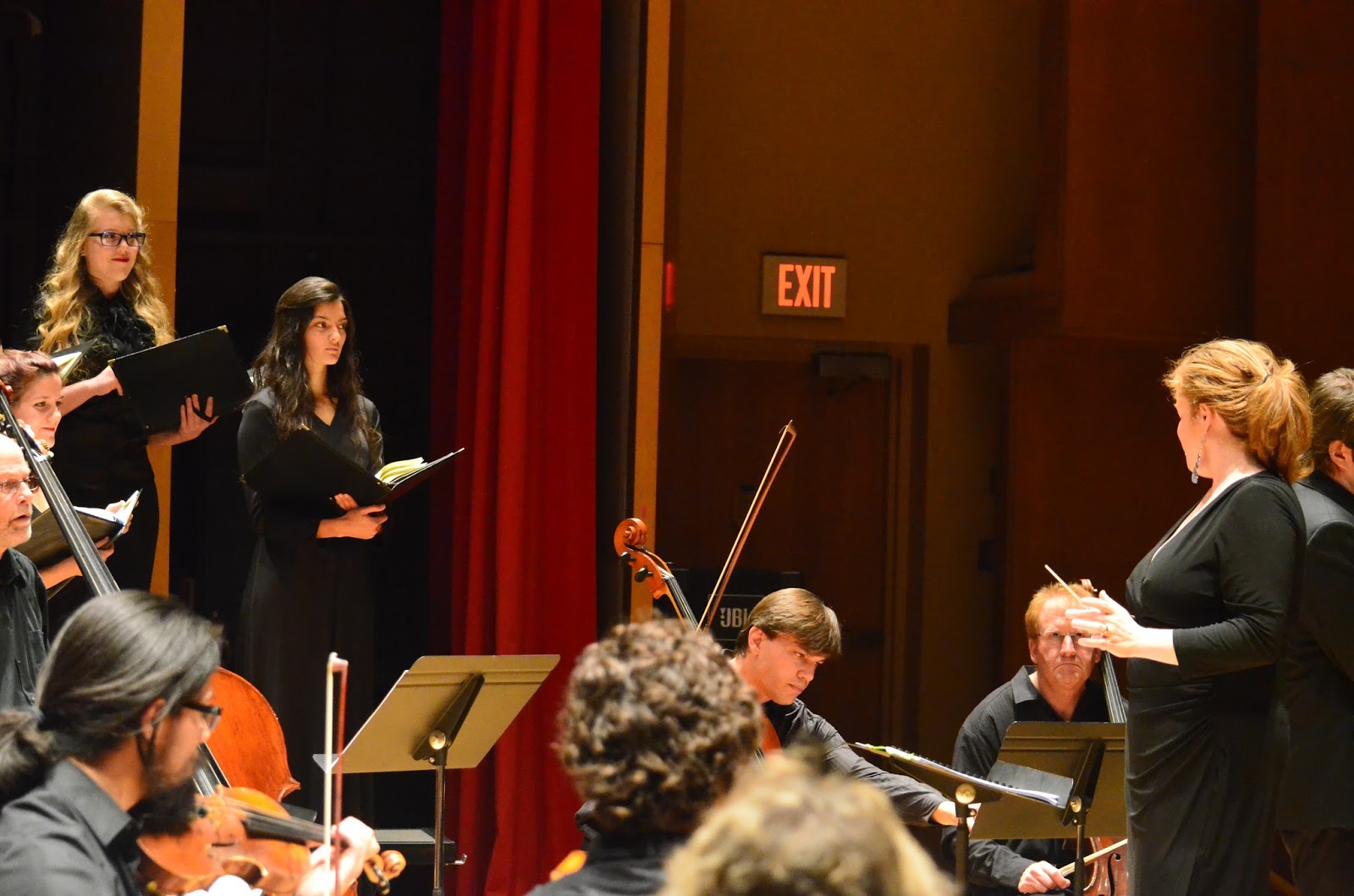
The photo is from our second recording session for the disc, January 2017! As I was saying to a dear friend today, "Progress is sometimes not linear." 

More details on purchase and release to follow. Please stay tuned here, as well as on Facebook, Instagram, and my website! 


Thursday, April 19, 2018

Sculpt

Augusta Read Thomas (read about her here) came to UNM for the Robb Composer’s Symposium in late March. The women of my beloved Chamber Singers gave a “world premiere” of a version of her piece, “Plea for Peace,” which had its world premiere in its original version just in the fall of 2017. 

Our version (which I really adored, as did she) was for unison women and string quartet. There isn’t a text, which she explained when she met with us and discussed the history a bit. It was commissioned to commemorate the Chicago Pile-1, the first artificial nuclear reactor. 

In addition to her amazingly warm spirit and generosity in the rehearsal and working session, I also loved her use of the word “sculpt.” when she was advocating for a more slender opening, for example. She had the women come in one at a time, and one or two with a different vowel. Those were things that I wouldn’t have thought to do.


Photo: With Ms. Thomas, post-performance.


We are grateful for her collaboration and the chance to perform her music!  

Thursday, January 4, 2018

Timing


As musicians, we think about timing - so - often. 

How much time does it take to prepare _____________ for a concert? There are all sorts of factors with this, including difficulty, style, how much else is going on “in life” at that time, does it have to be memorized or staged ... 

Then within a project, we must obsess over timing in every aspect. How long does it take to move-tune a harpsichord, for a violinist to make a string crossing, for a continuo group to “figure out” the feel of a piece, for a pianist to time a huge leap across the keyboard? How does a singer time a shift through the passaggio, to a high note, or time the initial plosiveness of a double consonant? 

For a performance, how much time do we take between songs or movements? How much is too much, or not enough, for the audience?

A small shift in a metronome marking (or speed) of something can make an enormous difference for the performers and audience. 

Sometimes, we prepare so much for these minuscule shifts, over analyzing them, even.

And just like that, when something is perfectly timed, by surprise, it is remarkable. 

As if God Himself has orchestrated it. 

“He has made everything beautiful in its time.” (Ecclesiastes 3:11, ESV). 


Friday, December 16, 2016

The day before ...

Greetings from a *cold* Harleysville, PA!

(I think all this time in NM, California, etc., has made my blood too thin for this).

I'm back at the "Ditlow Homestead" and have loved catching up with grandparents, brothers, sisters, parents, and my musical community to which I had such strong ties for the early part of my career. What is so exciting is that these ties have continued, and somehow even deepened, as we've all developed our lives and careers. A recent personnel change (due to weather) caused me to have to contact some people who I haven't seen or written to for a while, and I was moved by their immediate, warm responses and their willingness to help. (Problem solved, by the way!).

I've solved the epidemic problem of "Harleysville being on the edge of civilization" (meaning no Starbucks!) by taking matters into my own hands and bringing a milk frother, stovetop espresso maker, and Lavazza espresso with me. 


Tomorrow is "Bach by Candlelight" - and I couldn't resist making this "meme" ...


On this concert, I am the only person on it who gets the distinction of playing every piece - and really to play all "three" keyboard instruments. Within these works, I am charged with playing: 

1). 'orchestral' parts - multiple lines, covering for instruments we don't have ...
2). virtuoso solo music in the triple concerto (we're doing it on piano) - and the prelude and fugue isn't easy, either ... 
3). improvised and realized keyboard figured bass (but more than half of the music isn't figured) ... so essentially I'm making up the keyboard part in the right hand ... 

I found this quote from Bach which perfectly describes the magic of playing continuo:

"Like all music, the figured bass should have no other end and aim than the glory of God and recreation fo the soul; where this is not kept in mind there is no true music, but only an infernal clamor and ranting." 

I listened to rehearsal footage last night so that I can practice better today ... 


But there is also every genre possible in Bach's music - both looking back to Renaissance polyphony, and even the "rules" from plainchant or melodic construction - and - jazz, bebop, and ... heavy metal ... (there is a passage in the Bach d minor double violin concerto which makes me smile every time - it's Guns N' Roses, 260 years too early) .... 


Monday, June 20, 2016

Albuquerque, Summer of 2016


We are talking now of summer evenings in Albuquerque, New Mexico 


in the time that I lived there so successfully disguised to myself as a child.


 It was a little bit mixed sort of block, fairly solidly regular audience members,


with one or two juts apiece on either side of that.


The houses corresponded: middlesized gracefully constructed adobe houses built in the past hundred years,


with small front and side and more spacious back yards, and trees in the yards.


(with a little help from James Agee).

Thursday, March 10, 2016

Magnificat


This past Sunday, I got to make music in a way that I really "believed.” During the course of times that have been far too crammed, this came (strangely) as a huge blessing and gift.   

I have known the Bach Magnificat perhaps since undergraduate, when I played some of the solo arias in lessons for friends and colleagues. 
At Westminster Choir College, Dr. Andrew Megill led the Westminster Kantorei in a rehearsal and performance process that was life-changing.

Several other performances have followed.

When I was asked to take over (some) choral duties at UNM for this academic year, I bartered for the top auditioned choir. This year has been an amazing journey for me with them, as I have learned some things as a choral conductor “from scratch” (warm-ups, administration). Other things I feel have been a very natural extension of me (rehearsing a cappella, further development of ears, honing in on rhythm, controlling more lines of polyphony, further work on musicianship). 

The only thing I REALLY wanted to do, all year, was this piece. 
Thirty minutes of unadulterated joy. It’s also one of the most perfect pieces of music ever written. It’s the best of Bach (and that is saying a *lot*). Imagine my surprise when my colleagues delightedly volunteered to play in the orchestra. They were able to recommend graduate students to fill out the ranks.

One of my best students (a good undergraduate singer) said,

“The thirty minutes we shared on stage might be one of the best memories of my life. Doing anything."

Thank you.

As Bach said, "Soli Dei Gloria." 


Friday, December 18, 2015

The Force of J.S. Bach


We have a big concert (and two big concerti) tomorrow night! It’s the third annual “Bach by Candlelight.” Click here to purchase tickets. 


PHOTO: A Go-Pro photo of Bach practicing, Concerto in d minor, BWV 1052. Come on Saturday to hear it! 
 
Here is a video link to something I made. Click on this ...  See if you get the joke - you have to watch until the end of the video - 

And here is a quote by Glenn Gould that perfectly sums up why I / we do this concert every year, and my feelings on Bach’s music in particular …. 
 
"I think that if I were required to spend the rest of my life on a desert island, and to listen to or play the music of any one composer during all that time, that composer would almost certainly be Bach. 

"I really can’t think of any other music which is so all-encompassing, which moves me so deeply and so consistently, and which, to use a rather imprecise word, is valuable beyond all of its skill and brilliance for something more meaningful than that — its humanity."

Saturday, November 28, 2015

Continuo

"In order to be faithful to the written music, one must be prepared to alter the written notes." (from ON EARLY MUSIC)

What? 

I think it is easier for a classical musician to understand this as "one must know everything so well, and be so free, that one can transcend the score." 

In playing anything in public, but specifically an unrealized continuo part, one must call upon skill sets closer to what jazz musicians use. You have to be at home with form, harmony, sequences, riffs, licks, and gestures. You play as if to say, "Yes, and ..." 


I am an especially lucky girl these days. I have been able to borrow and practice on the collection of harpsichords which UNM has (they have *six* good instruments under lock-and-key in the basement!). 
These instruments tell stories in a way that a modern piano can't. Their uniqueness, and what the instrument will-or-won't hold, regarding tuning. 

I purchased a tuner for my iPhone (on encouragement from my historical performance teacher at Eastman, Paul O'Dette), which will help you tune an instrument within any "meister" or "comma" imaginable. When I do the Bach and Shostakovich project recordings, I will take advantage of this. 

Late November and all of December are two parties for baroque playing for me. Last weekend was another performance at Chatter (same great institution, just a different location) ...


(PHOTO: from my GoPro, playing some wild Biber pieces)

... and December 3-4 will be an off-shoot of "Movable Sol"'s concert series, "Barokk Werke Verzeichniss." (A play on BWV). On that docket are several preludes and fugues from WTC I (I have been doing more WTC II these days, but the WTC I is always wonderful to revisit), a Boccherini gamba sonata, and some works for unaccompanied 'cello.


December 19th will bring a blissful reunion with my wonderful trio back on the East Coast. I will get to perform again Bach's great Harpsichord Concerto in d minor (I last performed this in the winter of 2004. This performance has brought about new practice techniques, much more work and training since then on my technique and on harpsichord, and new scores and editions have come out since I last performed it). 

Here's to continuo until the end of the semester ... 

Thursday, October 8, 2015

Eastern Impressions


Zheng and I made our recital debut as a married couple yesterday. We had been invited to perform Chinese music, in combination of both violin and viola with piano (unaccompanied would have been fine, but we found music with piano parts. Well, most of them).

I assigned Zheng the task of finding the music and researching its origin (region, composer, a possible program). He did this with might aplomb. I noticed that the audience was very receptive and attentive. 

The third selection had only the solo part at the ready. My task - invent a part that was complimentary (and that didn’t sound like either hokey-Asian-pentatonic or something from the third grade). I was up to the task. I even inserted an homage to “The Devil Went Down to Georgia” before the fast section.  
This music is meaningful and specific to time-and-place. Zheng's explanations were very inviting to the audience. The music was *not* difficult, in terms of technical demands (pianistically) or difficult to understand for a first-time listener who was more of an avocational purveyor of concerts. 

What this taught me was ... we don't need to hit the audience over the head at *every* performance with cerebral, esoteric music. Light, tonal melodies and folk music very much has its place - even in 2015.

We will share more videos soon - enjoy this first one! You can find it by clicking on this link.

PHOTO: A photo from our rehearsal dinner!  
VIDEO: The second selection on our program - the "Mongolian Shepherd Song."

Friday, July 24, 2015

Preparation

I have thought so long that a piano should be, simultaneously, the substition and simulation of an entire orchestra. Organists might trump this in some ways, but pianists have a wide dynamic range through physical interaction with the keyboard. 

Twentieth-century composers became curious about color possibilities when a performer was asked to treat the strings with various things, therefore altering the sounds. John Cage asked performers to put nails, forks, tacks, felt, and various other objects in or on the strings. It would create colors closer to a gamelan, Indian drums, or an entire percussion section rather than a keyboard. 

Three of the pieces which I played recently in Germany called for "prepared piano." The composer will put some sort of key or legend in the music before the actual music begins. He or she will lay out a "map" of which notes to treat with which materials. One of the pieces called for some keys to be taped to the fallboard. Another piece asked for notes to be muted (and-or producing overtones) with some sort of putty. The putty in particular was easy because it was able to be removed quickly and re-used. 

I had not done a lot of music like this before initiating the "Albuquerque meets Darmstadt" project. Now, all of the sudden, I was immersed in the possibilities of color which the composers required. 


PHOTO: The inside of the piano while I was practicing "Pulstastung," a multi-movement work by my friend, UNM colleague, and amazing Darmstadt host, Dr. Karola Obermüller. 

Here is a further explanation from the "Prepared Piano" article on Wikipedia. Here is the link if you are interested - https://en.m.wikipedia.org/wiki/Prepared_piano

Although theoretically any object could be used to prepare a piano, in practical application preparation objects are usually expected to have certain characteristics:

  • They are applied directly to the piano strings.
  • They must fit in the desired location inside the piano.
  • They (usually) should not move from their location during playing.
  • They must be reversible (that is, when a properly prepared piano has been "unprepared", it should be impossible for anyone to tell that it had been ever been prepared; no permanent damage is done to the piano).

Additionally, most preparations will change the timbre of the string in such a way that the original pitch of the string will no longer be perceptible, though there are occasional exceptions to this.[1]

Sunday, July 19, 2015

Portraits and Dedications

Coming to Europe has always felt like a homecoming. Many Americans certainly can lay claim to European heritage: my own ancestors came from Italy, Wales, Switzerland, and (former East) Germany. Moreover, much of the music and literature which classical music students in the USA study comes from continental Europe. Even the cuisine of Germany has permeated the area of the country where I was raised. 

Part of the "Albuquerque meets Darmstadt" project is to present composers who are currently living and working as composers in Germany (and that have a tie in some way to either city). I had the distinct pleasure of meeting with composer Cord Meijering, director of the Akademie für Tonkunst, DA. 

His pieces are called "Portraits and Dedications." I got to hear the full story about his time at the Macdowell artist colony (New Hampshire, USA) and the people he met. I loved the tales - artists creating things out of frozen spiders; a Pulitzer Prize elderly author going for walks in the rain and hiding in the mist (she also often repeated herself - her "piece" shows it); a literature professor from the Pacific Northwest who had a quirky, wonderful sense of humor. 

Composers need a "point of entry" and why not start with living, breathing, people? 


PHOTO: the Akademie für Tonkunst (musical arts) sign. 

Friday, July 17, 2015

Tonight (and now, back to practicing)

http://www.ztix.de/event.php/725158

Tonight is my solo concert at the Darmstadt Akademie für Tonkunst. 

I am so grateful for the hospitality I have received by my hosts, Peter and Karola, their children and Karola's parents, Prof. Theo Nüßein, Prof. Mark Lutz, Professor Mr. and Mrs. Volker Blumenthaler, Ms. Monika Teepe, Mr. Cord Meijerling, Ms. Tara Venditti. 

I must also thank the many composers who have made contributions for tonight's programme: Drs. Karola Obermüller, Peter Gilbert, Rick Hermann, José-Luis Hurtado, Cord Meijering, Volker Blumenthaler. An additional (future) debt of gratitutde goes to Drs. Steve Block, Daniel Cummings, and David Bashwinner for future contributions to the "Albuquerque meets Darmstadt" project. 

I have so many wonderful memories from this week - a week I will never forget. 

Tschüß!


Monday, July 13, 2015

Surround Sound

The night after my arrival in Darmstadt, my friend-extraordinaire, composer-extraordiaire, and amazing host Peter and I took a voyage on the trams into the center of Darmstadt. It was to hear a piece written and "conceived" during the Darmstadt FerienKurse. 


PHOTO: Promotion poster, containing an interesting reflection. 
 
The work of the night was "Prometeo," (read more here - https://en.m.wikipedia.org/wiki/Prometeo) a tour-de-force for multiple choruses, orchestras, vocal soloists, ensembles, three conductors, and a team of virtuoso sound engineers. The total ensemble was split up and divided all around the room. The audience was asked to enter in small groups, wearing masks. We were then guided by an usher to our seats, which were arranged in circles of sixes, seatbacks together (so within an "island" of chairs, you faced out). At various points within the piece, the audience was asked to circle around two places, so that you could experience the "surround sound" in total.

Not only that, but for the opening "Prologo," you were asked to sit with your mask on. Despite my jet "leg" (see this post), I probably only nodded off for about 30 seconds of a masked prologue. Not bad. (Though I'm still suffering from some jet leg).


PHOTO: Promoteo-mask-selfie, taken in my practice space for the week.

Luigi Nono (bio is here - https://en.m.wikipedia.org/wiki/Luigi_Nono_(composer) ) was an avant-garde twentieth-century composer, Venetian-trained by Gian Francesco Malipiero (one of the comopsers who was the subject of my masters' thesis). He was a student at the Darmstädter Ferienkurse in the 1950s. According to the placard outside of the concert, "Prometeo" was conceived with the things that he had learned from his colleagues in Darmstadt. 


PHOTO: Here is a favorite shot of mine of Venice (ca. early June, 2012).

This isn't exactly a piece to take a road-trip listening to, but since performances are rare (size, difficulty, expense, electronic necessities), I'm thrilled that I was able to hear a performance of this quality, and in a location that was so important to its creation.

Friday, July 3, 2015

House-Music

The idea of the “portable concert” or “home concert” is nothing new.

As long as people have been willing to sit (or not), listen (or not), drink and eat (always), and contribute something to the affair, there have been incredible places that get transformed into concert venues.

The old idea of the “Schubertiade” took the first part of the 19th century by storm. The mother’s milk of Felix and Fanny Mendelssohn were Sunday Musicales, hosted by their parents to show off their children. Practically around the corner from the Mendelssohn parties (decades later) was the house where Robert and Clara Schumann raised many children, composed, and lived a life of music.

So who knew that Albuquerque, the home of “Breaking Bad” and “Better Call Saul” (both of which I love) could also be a fertile ground for house-concert music-making? 

I will write about the second “Moveable Sol” later today - that deserves another post. Two other things happened recently regarding house-music making, and both deserve their own posts. 

I had the good fortune to introduce myself musically to the Santa Fe Desert Chorale this past weekend. The invitation came from a recent UNM grad (now doing administrative work there!) and Dr. Michael Hix, my baritone colleague here at UNM (here is his website). 

The challenge with house concerts is of course, the instrument (or lack thereof). One of the reasons why I was able to take this gig was that I owned a Yamaha P70, or a weighted-key keyboard with a good sound and built-in speakers. It was a purchase I made back in 2008 and am glad every time I get a call when I need the instrument.

Bravo to the audience (and a big thank-you), to my partner Michael, and to the Santa Fe Desert Chorale on the beginnings of their summer season!


PHOTO: our “house concert performance"

Wednesday, June 24, 2015

(more) Chatter

It was funny to get a New Mexico-related work email about a month ago, actually as I was traveling back from Yellowstone (I was still in Montana). I was so pleased to be asked to play with two prominent string players in the ABQ area within about a month from the contact. 

The repertoire was: two sets of pieces by the Boulanger sisters, and the Dvořák "Dumky" trio. The "Dumky" had been on my "not that excited to play this piece" list for a long time, *but* the invitation was important because it involved not only terrific players, but also a concert series which I really enjoy in Albuquerque. (You can read about that series again in this post).

Part of the tricky, interpretative challenge with "Dumky" are the many tempo changes and transitions. I never realized this before, but my disdain for the work had probably come from a "bad" (read: uninspired, uninformed, unresearched) performance that I had heard at some point. I can't remember if the performance was live or a recording at this point, either. It doesn't matter. What matters is that I agreed to the performance, and once I say "yes," it's "yes" all the way.

Through a number of rehearsals, we worked out who led which transitions, what the audience was to listen for, which places to take (how much) time, and so forth. 

What was fun for me was to remember and imagine many wonderful experiences I've been lucky to have in Eastern Europe. Specifically, in the Czech Republic and Hungary. The experiences of combining parties, pálinka, and too much dancing and enough instruction to be dangerous. Those were, in some ways, "dumka" moments.

The idea of the "Dumka" is that it is a slow lament, which gradually works its way into a more festive, active dance. The "Trio," vaguely following a Sonata Allegro form, more accurately is in six "Dumky" - one leading into the next. 

I am so grateful to new colleagues James and Megan (you can read about them here) for the opportunity to collaborate, and for the transformative experience of making me love this work. 

PHOTO: From the concert. 


Tuesday, June 16, 2015

Impromptu


No one writes better 
neapolitan chords 
than Franz Schubert, 
and these days, 
between the delicious 
fantasy
in f minor 
for four hands 
on one piano,
or thinking
on lieder 
of
Goethe
and 
Mayrhofer 
(to take place in later summer),
I would rather have 
an
impromptu
meeting
with no one else. 
 
(June 16, 2015)


Thursday, May 14, 2015

The miraculous end of "Suor Angelica"

When musicians and non-musicians alike are asked about what they know about Giacomo Puccini, many would say,

“Great theatre composer / turn-of-the-twentieth-century opera composer / the guy who wrote “La bohème” / that Italian guy that followed Verdi / the last Italian opera composer …"

And so on.

All of these great composers in the past still hold a tantamount of questions. Do Musetta and Marcello ever really work things out, past Mimì’s death? Does Rodolfo ever get married again, and at what point in his new relationship does he reveal what [was] the love of his life? 

Being here on a double-bill of Suor Angelica and Gianni Schicchi, being immersed in these works has brought up many questions about Puccini, his compositional style, inspiration, and in Suor Angelica, some questions about faith. 

The opera begins with a chorus of nuns (i suori in Italian) singing backstage. Angelica appears early in the opera. She gets soaring melodies and rich (though in this work, crystalline and pastel) orchestration for which Puccini is famous. Through her, we meet a nun who is simultaneously like and unlike everyone else.

Often the nuns sing in order to set the tone (the opening “Hail Mary,” sung in Italian), to narrate or comment on the action (Greek-chorus style). They sing chants, triads, and even some gossipy music (these are a bunch of women, after all). 

Puccini utilizes off-stage music in many of his works. This piece is no exception. He also sets up the “end” - the final scene - note-by-note, for the first 45 minutes. Rather than explain the whole plot, you can read it here.

After she sings her lament about her boy dying without him knowing how much she loved him, we get more of a glimpse of her as a woman. I’ve always wondered how much of a “believer” in God she actually was - was she a misfit who was put into a convent as to avoid embarrassment by the family? Does she come to resent the Church during her “punishment” there? Or does she believe that if she “Hail Marys” her way out of this, she will eventually be forgiven by God, her family, and herself?

Her final scene (sung very brilliantly here in Bozeman by Maria Kanyova (her bio can be found here)) is a tour-de-force of vocalism, acting, and Puccini’s exquisite use of the backstage. Within Angelica’s final moments, she gets to stage an intermezzo (mostly the music which we have heard before and after the visit from her aunt), and kill herself using the poison she has made out of her herb garden. After the poison makes her hallucinate, she realizes that suicide is a mortal sin. The desired earthly or heavenly reunion with her son is not possible. 

The offstage-chorus juxtaposes the solo vocal rhapsody on stage. They sing a crisp “Regina Virginum, Salve Maria” in dialogue with the drama which is happening in front of the audience. After Angelica makes a heartrending plea for the Madonna to save her, the chorus responds with the tune Angelica has sung moments ago. 

On this production, I play both in the pit and backstage. Pit is organ and celesta (in a bigger house, this would be covered by several sets of hands); then I get to play backstage “organ” (it’s actually a Clavinova hooked up to an amp). In order to do so, I have to clamor through a backstage chorus (who is reading the final scene off of scores, and using their phones. Once I’m at the other instrument, it’s a deep breath - listen - follow the conductor and lead and follow at the same time.  

There are other “goosebumps” moments in this piece. For me, when the lowest soprano voices of the chorus of nuns sing an unprepared A-flat (in basically a C-major chord), that’s the magic of this whole piece. 

I love the questions which that particular notes brings. Why don’t they just sing a major chord? Or why not an E-flat, making the major chord minor, and damning Angelica to hell? 

The fact is, with this note, we don’t know exactly what happens. 

(If you are interested in reading a theoretical tract on this work, you may want to check out this article by James Hepokoski. You can find the article here.)


PHOTO: We are being housed generously by the opera company. This is a photo I took of our guest cabin out near a big trailhead on Bozeman's outskirts.


Wednesday, April 22, 2015

Still Falls the Rain

In 2004, the Tanglewood Music Center Vocal Fellows had the opportunity to perform all five of Britten’s Canticles in one concert. The repertoire was paired with some of Shostakovich’s music (the Captain Lebdyakin Songs, etc.), juxtaposing two of my favorite twentieth-century composers due to their dates (their birth and death dates are only a few years from each other). I someday hope to perform a cycle of all of the Canticles, even with staging or artwork or pageantry of some kind. Of course, they stand on their own, without theatrics. But they are from the pen of a man who so understood the stage. 

Below is pasted from my faculty recital (04/19/15). You can see a link to the video performance (live from Sunday) here.


_____________

 
The five Canticles of Benjamin Britten occupy a unique position in not only Britten’s compositions, but also within twentieth-century vocal music. Some are almost completely sacred and cantata-like, others fall purely into a category of secular or chamber music. Canticle III: Still Falls the Rain lies as the centerpiece of the quindrivium, and is an intersection of the sacred and secular. 

All of Britten’s Canticles pay homage and inspiration to his musical and romantic partner, tenor Peter Pears. They also refer to the operatic compositions which precede them. Still Falls the Rain is no exception. The opening musical motive is drawn directly from his chamber opera The Turn of the Screw. This canticle, with an obligato horn part, serves as a theme-and-variations, with interspersed recitative, upon musical motives which appear in the opera. 

This work was written for a memorial concert for Noël Mewton-Wood, a pianist who had committed suicide after the death of a close friend. Britten was a strong pacifist and hated the involvement of England in the Second World War. When he read Edith Sitwell’s poem ‘Still Falls the Rain (The Raids, 1940. Night and Dawn),’ he was drawn to it immediately and set forth on obtaining permission from Sitwell to set her text. She agreed. On hearing a live performance of this piece, she and Britten collaborated on a concert program for the 1956 Aldeburgh Festival, which included more of her poetry, and for which Canticle III served as its centerpiece. 

Within this poem, Sitwell uses a quotation from the final climactic scene of Christopher Marlowe’s Doctor Faustus. Britten sets this quotation in a sprechgesang fashion. 

Still falls the Rain---
Dark as the world of man, black as our loss---
Blind as the nineteen hundred and forty nails
Upon the Cross.

Still falls the Rain
With a sound like the pulse of the heart that is changed to the hammer-beat
In the Potter's Field, and the sound of the impious feet

On the Tomb:
Still falls the Rain

In the Field of Blood where the small hopes breed and the human brain
Nurtures its greed, that worm with the brow of Cain.

Still falls the Rain
At the feet of the Starved Man hung upon the Cross.
Christ that each day, each night, nails there, have mercy on us---
On Dives and on Lazarus:
Under the Rain the sore and the gold are as one.

Still falls the Rain---
Still falls the Blood from the Starved Man's wounded Side:
He bears in His Heart all wounds,---those of the light that died,
The last faint spark
In the self-murdered heart, the wounds of the sad uncomprehending dark,
The wounds of the baited bear---
The blind and weeping bear whom the keepers beat
On his helpless flesh... the tears of the hunted hare.

Still falls the Rain---
Then--- O Ile leape up to my God: who pulles me doune---
See, see where Christ's blood streames in the firmament:
It flows from the Brow we nailed upon the tree

Deep to the dying, to the thirsting heart
That holds the fires of the world,---dark-smirched with pain
As Caesar's laurel crown.

Then sounds the voice of One who like the heart of man
Was once a child who among beasts has lain---
"Still do I love, still shed my innocent light, my Blood, for thee."

Monday, April 20, 2015

Faît accompli!

Yesterday was a great day.

I got to share music with new friends and colleagues, who, a year ago, I had just met. One year later, we were rehearsing, forming our own “community” as a vocal department of five, and then - of course - properly celebrating afterwards with a Chinese food reception! 

Heartfelt thanks to everyone - my faculty partners, the faculty there to support, the crew of Keller Hall, the audio and video crew, my family for cooking the reception … 

There will be more photos, along with beautiful sound and video forthcoming! 

In the meantime, enjoy photos of the “celebration” afterwards. 


Sunday, April 19, 2015

The day-of ...

I remember saying to someone that nerves might kill me if I perpetually had to perform, task after task, starting at 8 or 9 PM. (One of the many reasons that I would never be able to cut it as a jazz musician). 

My recital today is at 5PM and I'm already in performance-mode, meaning -- 
hyper-focused, and not in the mood to run random errands this morning (I rarely am, and I'm not a big fan of running errands for three hours on the weekend). I want to perform beautifully with my colleagues and then not have the pressure of performance hanging over my head anymore for this project.

It is times like this where I try to borrow from experts who negotiate this a lot. I found this terrific link:

http://www.bulletproofmusician.com/how-to-make-performance-anxiety-an-asset-instead-of-a-liability/

And I think today I'm going to tend to my need for silence as much as possible. I'm going to go for a walk and then warm up, do my hair, and get to school hours early. (One of *many* advantages of performing where you work - you get a fabulous, private, "green room" one flight above the hall). 

I am grateful for my colleagues (seven of them!) who will be joining me on stage, and hopefully some more in the audience. 

I will let you know how it goes! 

PHOTO: A very fitting photo for half of today's program: Brahms Opus 120 no 1 and the Schumann Spanish Songbook (for vocal quartet and one pianist), Opus 74. The other works on the program are Brittish, French and American. I took this photo today while in the Erzgebirger region hiking near Dresden, summer of 2012.