Showing posts with label audience. Show all posts

Friday, December 18, 2015

The Force of J.S. Bach


We have a big concert (and two big concerti) tomorrow night! It’s the third annual “Bach by Candlelight.” Click here to purchase tickets. 


PHOTO: A Go-Pro photo of Bach practicing, Concerto in d minor, BWV 1052. Come on Saturday to hear it! 
 
Here is a video link to something I made. Click on this ...  See if you get the joke - you have to watch until the end of the video - 

And here is a quote by Glenn Gould that perfectly sums up why I / we do this concert every year, and my feelings on Bach’s music in particular …. 
 
"I think that if I were required to spend the rest of my life on a desert island, and to listen to or play the music of any one composer during all that time, that composer would almost certainly be Bach. 

"I really can’t think of any other music which is so all-encompassing, which moves me so deeply and so consistently, and which, to use a rather imprecise word, is valuable beyond all of its skill and brilliance for something more meaningful than that — its humanity."

Wednesday, December 9, 2015

Count-down


I forever love the quote from a book I read about the Guarneri String Quartet. They (jokingly) make light of the fact that there is rarely any money in chamber music, and when there is any money, it certainly isn’t much. I am determined to solve this problem. 

The arts don’t sustain themselves financially. In the days when Bach would have been alive, he was essentially writing “pop music,” much in the vein of how a praise band would write a chart for a contemporary worship service. Back in those days, we didn’t have “early musicians,” rock musicians,” “pop musicians,” or “classical musicians.” 

We had musicians.

And we need to go back to that. There is just as much to learn from Jimi Hendrix’s “Star Spangled Banner” improvisation and Billy Joel’s amazing piano lick in “Scenes from an Italian Restaurant” (the one in G Major, right before the “Oh-oh’s,” and before the great re-transition to F Major) as we can from studying the cadenza to … basically any instrumental concerto in the canon.

I have long worked on the precision and cleanliness in my playing, and it has come along way. Any musician who plays classical music needs to then swing the pendulum in the other direction, as to call upon the spirit and presence of the original. As if to say, “Bach is in the room. Let’s groove it.”  


PHOTO: Lukens Trio and Friends, from “Bach by Candlelight 2014"

Or another way to think of it is to “transcend” the instrument. Beethoven, in speaking to Schuppanzigh, said, 

“Do you think I worry about your lousy fiddle when the spirit speaks to me?” 

(this was after Schuppanzigh complained about the difficulties that he encountered when playing one of the quartets).

My goal in playing the d minor Bach concerto coming up will be to (of course) play accurately … 

but even much more than that ...

to make the listeners feel like we have taken a time machine back to Leipzig, and we are listening to some of the greatest music ever written and enjoying the thrill of the idea that it “could” have been created on the spot.

If you would like to attend our concert on 12/19/15, please consider reserving your space in advance. You might even consider a CD! You can click here (Lukens Trio Kickstarter) to learn more about that. Thank you! 

Saturday, November 28, 2015

Continuo

"In order to be faithful to the written music, one must be prepared to alter the written notes." (from ON EARLY MUSIC)

What? 

I think it is easier for a classical musician to understand this as "one must know everything so well, and be so free, that one can transcend the score." 

In playing anything in public, but specifically an unrealized continuo part, one must call upon skill sets closer to what jazz musicians use. You have to be at home with form, harmony, sequences, riffs, licks, and gestures. You play as if to say, "Yes, and ..." 


I am an especially lucky girl these days. I have been able to borrow and practice on the collection of harpsichords which UNM has (they have *six* good instruments under lock-and-key in the basement!). 
These instruments tell stories in a way that a modern piano can't. Their uniqueness, and what the instrument will-or-won't hold, regarding tuning. 

I purchased a tuner for my iPhone (on encouragement from my historical performance teacher at Eastman, Paul O'Dette), which will help you tune an instrument within any "meister" or "comma" imaginable. When I do the Bach and Shostakovich project recordings, I will take advantage of this. 

Late November and all of December are two parties for baroque playing for me. Last weekend was another performance at Chatter (same great institution, just a different location) ...


(PHOTO: from my GoPro, playing some wild Biber pieces)

... and December 3-4 will be an off-shoot of "Movable Sol"'s concert series, "Barokk Werke Verzeichniss." (A play on BWV). On that docket are several preludes and fugues from WTC I (I have been doing more WTC II these days, but the WTC I is always wonderful to revisit), a Boccherini gamba sonata, and some works for unaccompanied 'cello.


December 19th will bring a blissful reunion with my wonderful trio back on the East Coast. I will get to perform again Bach's great Harpsichord Concerto in d minor (I last performed this in the winter of 2004. This performance has brought about new practice techniques, much more work and training since then on my technique and on harpsichord, and new scores and editions have come out since I last performed it). 

Here's to continuo until the end of the semester ... 

Saturday, November 21, 2015

Art-Song


My first experiment (or experience, if you would like to call it that) in “playing art” was successful! Here’s what it involved: 


- immediate audience reaction 
- audience participation, using vocabulary which they were comfortable with (contrast, line, shape, architecture, length). 

*The above mentioned “architectural” comments are also completely musical. 

Some of the improvisations were very strong. I am working on getting some audio footage edited to photograph-stills … but those can’t be released until all parties have “signed off” on the material, so to speak.  


I really loved this event and I hope to do more. I also hope to get my students involved. There could be such potential for this - in places such as the East Coast, definitely in Europe or China! I hope to farm out the idea to galleries or museums also in my local state. 

Perhaps the best two things from a perspective of the audience:

- They sat and looked at a painting, even if it wasn’t their favorite, for *much* longer than a usual visit.
- The paintings “changed” for them as they “listened” to them. 


Photos are taken by yours truly, with a GoPro set up on a foldable tripod and taken remotely with my iPhone.


Sunday, November 15, 2015

Pictures at an Exhibition


It isn’t often that one’s “second layer of talent” gets to be utilized. Artists are often clobbering each other, in order to use the “thing” they deem as their “first string” talent level. 

Pianists, it’s the chops. Singers, it’s the voh-chay. (Yes, perceived sarcasm is directly understood). Other instruments, I’m not sure. (Long notes for tuba?). 

It’s the dermis talent (as opposed to epidermis) that gets us where we need to go long-term. 

I received a request a few months ago for an upcoming performance. And in doing so, I get to use my strange, spontaneous thinking and improvisational skills.

The assignment? 

“Play works of art at a gallery.” With a singer. No music. But we play the art (or sing it). We play gestures and come up with contrast, movements, harmonies, melodies, conversation, points of focus, lines, perspectives …  


Today was our final rehearsal and - people should run to hear and see what we are creating. 

The Albuquerque Museum is hosting its “3rd Thursday” event. It has invited curator Oliver Prezant (read a little about him here) ... 

 
soprano Cecilia Leitner (more about her here), a poet, and myself. Cecilia and I have had several rehearsals of … musical improvisation related to the art on the walls.

Since we have had to rehearse while the museum is open to the public, we have had passers-by become involved in the painting. Oliver has been guiding the audience and Cecilia and myself to share and experience the art in a unique way.  


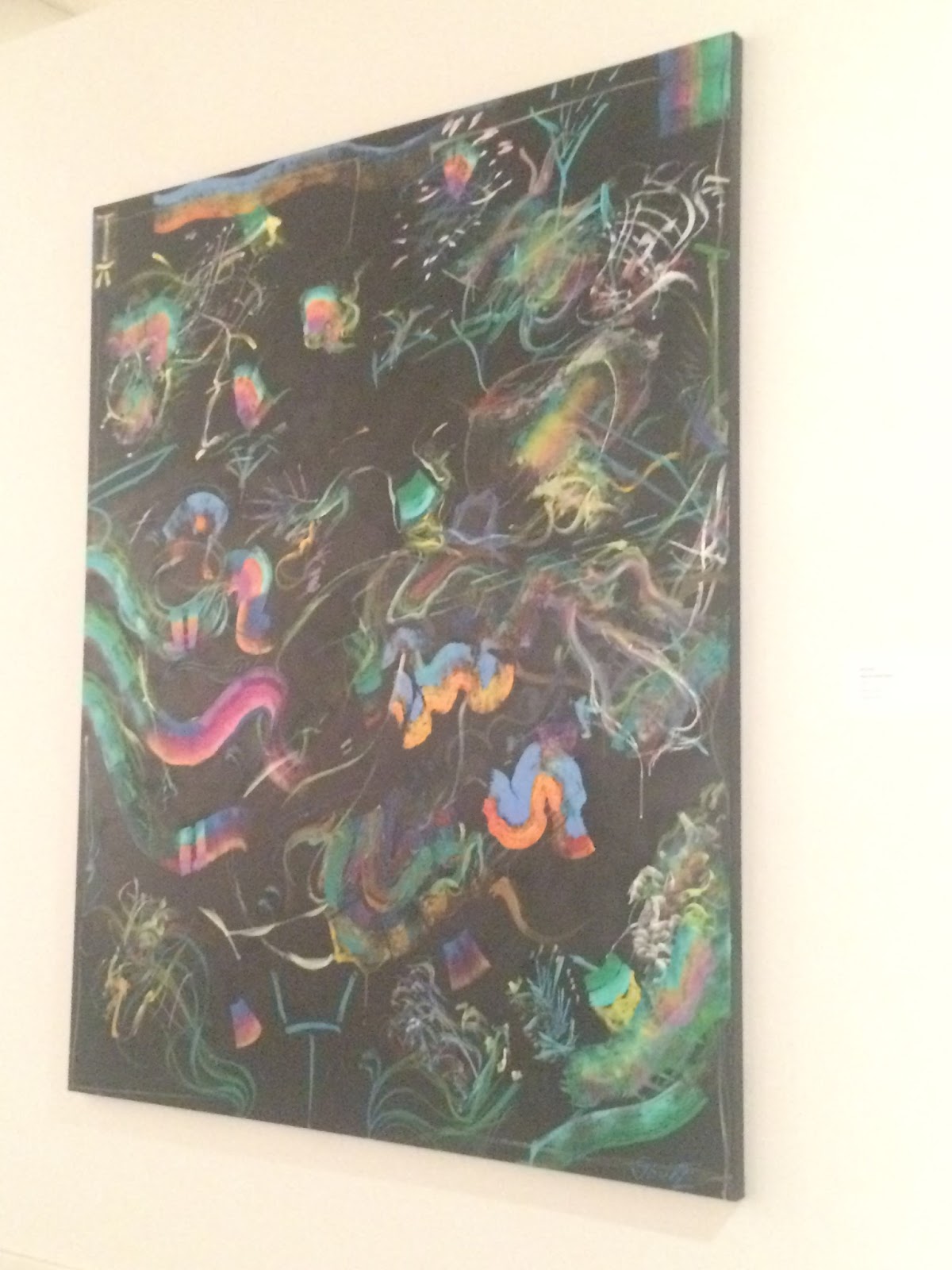
The other day, we were creating a multi-movement piece based on this painting. Oliver then had the audience make hand-shapes and gestures related to the visual and aural art!  


Today, we created a piece based on a portrait of a young boy holding a chicken. (You have to come to the exhibit to see this one!). In one way, the painting is totally “ignorable” and a walk-by. But today, people were present at this painting for close to ten minutes

Usually, art museum guests look at paintings, on average, for about 10 seconds. 

We increased the audience-time ratio of “Boy with Chicken” by 6000%. 

Who said art isn’t a great investment?

Thursday, October 8, 2015

Eastern Impressions


Zheng and I made our recital debut as a married couple yesterday. We had been invited to perform Chinese music, in combination of both violin and viola with piano (unaccompanied would have been fine, but we found music with piano parts. Well, most of them).

I assigned Zheng the task of finding the music and researching its origin (region, composer, a possible program). He did this with might aplomb. I noticed that the audience was very receptive and attentive. 

The third selection had only the solo part at the ready. My task - invent a part that was complimentary (and that didn’t sound like either hokey-Asian-pentatonic or something from the third grade). I was up to the task. I even inserted an homage to “The Devil Went Down to Georgia” before the fast section.  
This music is meaningful and specific to time-and-place. Zheng's explanations were very inviting to the audience. The music was *not* difficult, in terms of technical demands (pianistically) or difficult to understand for a first-time listener who was more of an avocational purveyor of concerts. 

What this taught me was ... we don't need to hit the audience over the head at *every* performance with cerebral, esoteric music. Light, tonal melodies and folk music very much has its place - even in 2015.

We will share more videos soon - enjoy this first one! You can find it by clicking on this link.

PHOTO: A photo from our rehearsal dinner!  
VIDEO: The second selection on our program - the "Mongolian Shepherd Song."

Monday, July 13, 2015

Surround Sound

The night after my arrival in Darmstadt, my friend-extraordinaire, composer-extraordiaire, and amazing host Peter and I took a voyage on the trams into the center of Darmstadt. It was to hear a piece written and "conceived" during the Darmstadt FerienKurse. 


PHOTO: Promotion poster, containing an interesting reflection. 
 
The work of the night was "Prometeo," (read more here - https://en.m.wikipedia.org/wiki/Prometeo) a tour-de-force for multiple choruses, orchestras, vocal soloists, ensembles, three conductors, and a team of virtuoso sound engineers. The total ensemble was split up and divided all around the room. The audience was asked to enter in small groups, wearing masks. We were then guided by an usher to our seats, which were arranged in circles of sixes, seatbacks together (so within an "island" of chairs, you faced out). At various points within the piece, the audience was asked to circle around two places, so that you could experience the "surround sound" in total.

Not only that, but for the opening "Prologo," you were asked to sit with your mask on. Despite my jet "leg" (see this post), I probably only nodded off for about 30 seconds of a masked prologue. Not bad. (Though I'm still suffering from some jet leg).


PHOTO: Promoteo-mask-selfie, taken in my practice space for the week.

Luigi Nono (bio is here - https://en.m.wikipedia.org/wiki/Luigi_Nono_(composer) ) was an avant-garde twentieth-century composer, Venetian-trained by Gian Francesco Malipiero (one of the comopsers who was the subject of my masters' thesis). He was a student at the Darmstädter Ferienkurse in the 1950s. According to the placard outside of the concert, "Prometeo" was conceived with the things that he had learned from his colleagues in Darmstadt. 


PHOTO: Here is a favorite shot of mine of Venice (ca. early June, 2012).

This isn't exactly a piece to take a road-trip listening to, but since performances are rare (size, difficulty, expense, electronic necessities), I'm thrilled that I was able to hear a performance of this quality, and in a location that was so important to its creation.

Friday, May 15, 2015

Complimentary

"Everyone likes a compliment.” - Abraham Lincoln 

It is only several hours before the show opens here in Bozeman, Montana (Intermountain Opera Theater). Today has been so wonderful - woke up rested, went running on the trail near our cabin - 


and then indulged in a regular routine well-known to those in theater.

[Opening night cards.]


I remember getting used to this tradition and really worrying about if I was “doing it right.” There isn’t a way to do them right or wrong (okay, maybe telling really inappropriate jokes in a card to the president of the board might not be a good idea. That would be “wrong.”).

But I wanted to take the time to really thank people for what they had brought to the rehearsal process. One colleague here was a colleague eight years ago at Merola. Another one had me play a separate audition for him while we were here and then we had a nice lunch after. A third is a full-time mom with many children, but she has devoted some volunteer time to coordinate some opportunities for school kids to hear more about our profession and stories. It does take a village to put on an opera, and to keep a company (of any size and in any location) running.

It is human nature to like to receive compliments. We actually need them. Mark Twain said, “I can live for two months on a good compliment.” 

However, it doesn’t seem human nature to give good compliments these days. In this day of social media (a very beloved mentor who does not use the platforms calls them all “My Face,” which gives me such a chuckle every time I think about it), people are complimenting themselves, while really accounting for how inadequate they feel. I got reports from a friend that she encountered someone who was so self-“complimentary” that it was grotesque. 

This will kill art if it continues.

One of the lifelines that we all have is to compliment each other - to bring out the best in each other so that we in turn can do our jobs and bring this gorgeous art form to life. It matters not if the people are managed professionals in the highest places, or if they are still students, on the way to figuring out this business. 

One of the best compliments I have ever received happened a few days ago. I was in rehearsal and the different managers and directors of InterMountain Opera Bozeman asked me if I was interested in being interviewed about my job on this production. I was interviewed and wrote about it here, and was pleased to read the article today. The columnist, Rachel Hergett, did a wonderful job in writing about the things which we spoke. You can read the article here. In asking me to do this, my colleagues paid me a compliment about my work. 

But the cycle must continue. I wrote to all of my colleagues today, thanking them wholeheartedly for their efforts to bring this piece to life. 

I paid an inadvertent compliment to my barista today too (I have no internet at home, so necessity in terms of keeping up with the world brings me to coffee shops while here). He brought me some espresso with some foam on top - and I took a picture of the image. He said, 

“The biggest compliment I get is when someone takes a picture.” 


Here’s to compliments of all shapes, sizes, and types. 


Thursday, May 14, 2015

The miraculous end of "Suor Angelica"

When musicians and non-musicians alike are asked about what they know about Giacomo Puccini, many would say,

“Great theatre composer / turn-of-the-twentieth-century opera composer / the guy who wrote “La bohème” / that Italian guy that followed Verdi / the last Italian opera composer …"

And so on.

All of these great composers in the past still hold a tantamount of questions. Do Musetta and Marcello ever really work things out, past Mimì’s death? Does Rodolfo ever get married again, and at what point in his new relationship does he reveal what [was] the love of his life? 

Being here on a double-bill of Suor Angelica and Gianni Schicchi, being immersed in these works has brought up many questions about Puccini, his compositional style, inspiration, and in Suor Angelica, some questions about faith. 

The opera begins with a chorus of nuns (i suori in Italian) singing backstage. Angelica appears early in the opera. She gets soaring melodies and rich (though in this work, crystalline and pastel) orchestration for which Puccini is famous. Through her, we meet a nun who is simultaneously like and unlike everyone else.

Often the nuns sing in order to set the tone (the opening “Hail Mary,” sung in Italian), to narrate or comment on the action (Greek-chorus style). They sing chants, triads, and even some gossipy music (these are a bunch of women, after all). 

Puccini utilizes off-stage music in many of his works. This piece is no exception. He also sets up the “end” - the final scene - note-by-note, for the first 45 minutes. Rather than explain the whole plot, you can read it here.

After she sings her lament about her boy dying without him knowing how much she loved him, we get more of a glimpse of her as a woman. I’ve always wondered how much of a “believer” in God she actually was - was she a misfit who was put into a convent as to avoid embarrassment by the family? Does she come to resent the Church during her “punishment” there? Or does she believe that if she “Hail Marys” her way out of this, she will eventually be forgiven by God, her family, and herself?

Her final scene (sung very brilliantly here in Bozeman by Maria Kanyova (her bio can be found here)) is a tour-de-force of vocalism, acting, and Puccini’s exquisite use of the backstage. Within Angelica’s final moments, she gets to stage an intermezzo (mostly the music which we have heard before and after the visit from her aunt), and kill herself using the poison she has made out of her herb garden. After the poison makes her hallucinate, she realizes that suicide is a mortal sin. The desired earthly or heavenly reunion with her son is not possible. 

The offstage-chorus juxtaposes the solo vocal rhapsody on stage. They sing a crisp “Regina Virginum, Salve Maria” in dialogue with the drama which is happening in front of the audience. After Angelica makes a heartrending plea for the Madonna to save her, the chorus responds with the tune Angelica has sung moments ago. 

On this production, I play both in the pit and backstage. Pit is organ and celesta (in a bigger house, this would be covered by several sets of hands); then I get to play backstage “organ” (it’s actually a Clavinova hooked up to an amp). In order to do so, I have to clamor through a backstage chorus (who is reading the final scene off of scores, and using their phones. Once I’m at the other instrument, it’s a deep breath - listen - follow the conductor and lead and follow at the same time.  

There are other “goosebumps” moments in this piece. For me, when the lowest soprano voices of the chorus of nuns sing an unprepared A-flat (in basically a C-major chord), that’s the magic of this whole piece. 

I love the questions which that particular notes brings. Why don’t they just sing a major chord? Or why not an E-flat, making the major chord minor, and damning Angelica to hell? 

The fact is, with this note, we don’t know exactly what happens. 

(If you are interested in reading a theoretical tract on this work, you may want to check out this article by James Hepokoski. You can find the article here.)


PHOTO: We are being housed generously by the opera company. This is a photo I took of our guest cabin out near a big trailhead on Bozeman's outskirts.


Sunday, April 26, 2015

Moveable Sol

One of my lifelong dreams as a musician is to cultivate small "groups" which are conduits to live, intimate performance in unconventional spaces. (This is nothing new on the classical music scene.) in fact, the idea of doing "opera on tap" (in bars), on-site in different places (my good friend and colleague from undergraduate has started On-site Opera (http://osopera.orgbringing people into wax museums and palaces to experience this medium live. 

Joel Becktell, cellist, friend, and entrepreneur (http://joelbecktell.com) had approached me back in January, while we were preparing the Schnittke Cello Sonata no. 1, about ... starting a house-concert series in Albuquerque. There are two salon-house-concert series which I know intimately from the East Coast - Rob Tannen's "Salon 33" and Andrea Clearfield's "Salon." (Princeton and Philadelphia, respectively). 

Joel's suggestion was to combine forces with his neighbor, a wonderful pianist, fellow creative, writer, teacher, and Albuquerque native Amy Greer (http://tenthousandstars.net). The suggestion was brilliant. 

After many emails going back-and-forth between us, we came up with a name. 

Moveable Sol. 

... many people thought is was "sun," others thought it was a play on moveable "do." (Drumroll please, for a musical pun). Others thought the sol had a "u" in it. The answer is, it's all of those things. 

We catered it. We shared our invitations with a mailing list. 

We sold out! 


One of the things that was most moving to me was hearing Amy and Joel perform a piece by Gjeljo, and also to hear Amy alone in some theme-and-variations on "O Sacred Head" (the latter by jazz pianist Fred Hersch). Since it was a house concert, and seating was fairly at a premium, I sat close to the crook of the piano. It had been forever since I've stood or sat there. It was a reminder about what my singers and instrumentalists deal with so frequently. 


I was reminded of the sheer power of music. 

The next performances are in June, with a location disclosed with reservation. 

PHOTOS: from the performance! One of these speaks so wonderfully to the name of the series. 


Monday, April 20, 2015

Faît accompli!

Yesterday was a great day.

I got to share music with new friends and colleagues, who, a year ago, I had just met. One year later, we were rehearsing, forming our own “community” as a vocal department of five, and then - of course - properly celebrating afterwards with a Chinese food reception! 

Heartfelt thanks to everyone - my faculty partners, the faculty there to support, the crew of Keller Hall, the audio and video crew, my family for cooking the reception … 

There will be more photos, along with beautiful sound and video forthcoming! 

In the meantime, enjoy photos of the “celebration” afterwards. 


Thursday, February 12, 2015

What's all the "Chatter" about?

Yesterday was an important “debut” for me in Albuquerque. There is a unique, 50-weeks-per-year series in town, which has a tremendous following and is an institution of the highest creativity (with a little bit of “crunchiness”). 

It’s called “ChatterABQ." You can view the website here.

The organization and events which it sponsored used to be called “Church of Beethoven.” It is a one-hour event, every Sunday morning at 10:30AM. Tickets are sold on-line and also at the door (though a special guest, who I had invited yesterday, said he got the last ticket!). Performers are booked months in advance and the repertoire ranges from Bach Cantatas to Pärt or Schnittke or world-premieres. For the price of a ticket, you are treated to about an hour of music, some poetry, and two minutes of silence. The venue which hosts this, the Kosmos Art Gallery in Albuquerque, is an old warehouse which has been re-purposed as a performance venue and artists’ loft. 

The ticket also includes some pretty fantastic coffee and biscotti-pastries-croissants, of your choice. You just have to get there early to get your “free” coffee and get a good seat!

Joel Becktell, cellist and baroque cellist, had invited me to participate in a concert with him back in August, when I came to another event at Chatter. After this event, we came up with the program in the parking lot of the gallery. The past weeks have been spent working through the Schnittke First Sonata (1978) and the Bach Third Gamba Sonata, in g minor. 

I have long loved the process of analyzing music, either for the first time, or examining something again under close lens when it has been “put away” for a while. I most recently performed the g minor Gamba Sonata with Wendy Richman (a long-time friend from Oberlin, Eastman, and who is now on the faculty of University of Alabama). It was wonderful to take out the old Bärenreiter part and re-work it, thinking about different possibilities of cross-phrasing, hemiolas, tendency tones, and evaded cadences. Ah, J.S. Bach, how you continue to make me swoon ...

The Schnittke was another matter, as yesterday was its first performance for me. The piece is a bit of a “bête noire” - as Joel puts it. There are pacing decisions, texture challenges, not to mention the technical demands put upon both players. 

The audience responded in exactly the way I hoped they would. Ears have to get acclimated to the relative quiet sounds of a five-string baroque cello with a harpsichord. They were “with” us in the Bach in that way! I could especially tell during the arioso slow movement. The Schnittke brought about an entirely different reaction, including audible real-time gasps at the shocking climax of the middle movement.

I am so grateful to this institution for what it does in promoting live music, poetry, and a community who relishes both in such an “espresso” way.

PHOTOS: Aziza Murray from ChatterABQ, 2/8/15.


Monday, September 30, 2013

Tour de Musique

Greetings from a delicious day off! 

9-90 of the 2013 Syracuse Opera Resident Artists had a Triduum of performances this weekend. We went up to Watertown Friday night, Syracuse was Saturday, and my "hometown" - Rochester - was Sunday afternoon! Zheng had to work, but Aying came to the concert. She loved it! One of my Rochester "partners-in-crime," Connie, was also there,

Of special note yesterday was getting to play "Piangerò" on a harpsichord! The facilities manager at Hochstein asked me, "Why would you play *that?*" My response was, "This is more accurate for what Handel would have used than a piano!" 

I posted last week about the Champagne Tour and Tasting for the Barnes Foundation. You read about that by clicking 


This week has brought more outreach and getting out into the "community" of Central New York. It has been inspiring to do this. People are excited to see us (***) and it has been enjoyable seeing people at multiple events. It seems we have a "fan club."

(***) Two of the Resident Artists were asked to do "guerrilla opera" at various downtown Syracuse restaurants for a festival. At the bottom of their contract, it stated, 

"If anyone asks you to leave, do so immediately." Apparently that only happened once. I think it's incredibly funny. 

PHOTOS: Vanessa Finch took some great shots from the Champagne Tour. Thank you!


Friday, September 27, 2013

Tour de Force, Tour de Champagne

Last Saturday, one of the Resident Artists and I had a "job" - which was to entertain the donors at the Barnes Foundation Champagne Tasting. 

It makes me want to work very, VERY hard. These events are terrific and it is a motivation to work hard, and then be able to give back. There were all local Finger Lakes champagnes and local food pairings. 

And an oppulently decorated old historical mansion. 

It was neat to see the reaction that the audience had to hearing an operatically trained voice sing live. We don't get to see this as audience members with the stage-audience distance. But here, we could see their reaction right away. 

Had I had the camera with me, the pictures would be better. This is what I could sneak with the iPhone. 


Wednesday, September 18, 2013

Gratitude, part 1

Since Monday was a "company day off" and Tuesday was a "we don't need you today" day off, I am writing from the "beginning" of Week 2 at Syracuse. We've had our first complete show of "9-90" and we had a performance today for the residents at a rest-home in Auburn. 

One of the best things I've heard about the audience, from the perspective of a conductor, was from our boss's friend (this friend is a stage director). The friend is being quoted as saying:

"In all of the shows that I direct, I never forget to be grateful to the audience. To really thank them. Because without them, I wouldn't have a job at all. And the weeks / months / years of preparation for projects wouldn't mean anything without people actually showing up."

So, I offer this post in sincerest gratitude of the audience. We would be nothing without them. I will continue to thank the audience to myself, and out loud, for every performance, for the rest of my life.

PHOTO: A sign inviting the audience to our first 9-90 concert, in Syracuse, NY.


Tuesday, November 27, 2012

Front-Row Seats

Front-Row Seats

Hello everyone!

(A big thank-you to VEFM and BD for helping me fix my blog-issues.).

We are leaving Shanghai early tomorrow morning.  I realize that I haven't yet posted about my reactions from the Beijing concert, and I believe that they are important to share.  Our performance in Shanghai is tonight at 7PM at the Conservatory of Music, followed by a "reception dinner."  

Our performance (and really, our entire time) in Beijing was another beautiful reminder about why I do this - why I am an artist, why I have chosen and have been chosen to be a collaborative pianist, why I travel, and why I enjoy playing with Ellen so much.    

I will first reflect on the experiences I had teaching the violists and pianists at the Beijing Conservatory of Music.  I found the students to be open, well-prepared, and eager to learn more.  Ellen and I tag-teamed the students on the day prior to our concert.  I taught in public, for the first time in my life, the E-major solo violin partita (but violists play it in A).  What makes this interesting is that I do not play any stringed instrument nearly at the level that any of these students do, and when I did study the violin, I had no business studying or playing any of the Bach unaccompanied works.

However, I do love them.  I listen to them when I need to be "alone with music."  And I have played Bach's keyboard music since I was a young girl.  I have coached vocalists on it, played rehearsals for cantatas and the major Passions, and have performed a good amount of the Preludes and Fugues, English Suites, Partitas, concerti, and all of the two-and-three part Inventions.  So, I guess that made me qualified to say something.  I think I helped, and Ellen was very positive about my input to that student in particular.  I also had more to say to the piano-viola duos.  

One moment during the class that was incredibly touching was Ellen's demonstration of the opening of the Bruch "Romance."  I teared up, immediately, upon hearing it, and her husband (next to me at the time) did as well.  She played it intimately and beautifully, as if she herself was writing it, and talking to someone.

The concert, last Saturday night (only 4 days ago!), was a wonderful experience as well.  In the front-row were Zheng and his mother, Ayuen (our hosts for the first week and our traveling companions to the Great Wall and to the Forbidden City).  In fact, I could see them very clearly from where I was sitting.  The audience was peppered with people video-taping the concert - with pretty high-powered video equipment, iPhones, iPads, other tablets, etc.  

Though the image that I will never forget is what happened during the first piece of our second half, Messaien's "Louange à l'Éternité de Jésus."  This is the first piece that Ellen and I ever played together (it's the cello movement of the "Quartet for the End of Time.").  Messaien has notated it in such a way as to eliminate the feelings of barlines, or really, time at all.  The piano part isn't technically demanding, but the bow-control issues and keeping the tempo slow enough make it challenging for any musician.  Because of my (relatively) easier part, I was able to take in the audience's reaction to the piece while we were playing it.  

There was a young Chinese man, maybe aged 14, in the front row.  He was sitting there, his eyes closed, and looked totally transported by this music.  Was he moved by the inexorable rhythmic quality?  Ellen's etherial vocalism?  Or the message of the piece itself?  I dare mention that it could have been the first time some of the audience had seen the word "Jesus" in print. 

I have noticed here that the pings and pangs of church-bells are noteably absent in China.  Compared to my "beaten paths" around Europe, the sounds of these cities are markedly different.  Noisier in some ways, and more silent in others.  

I dare say that Ellen and I made our mark on Beijing, but certainly this man in the front row.  My job as a sound-painter was able to insert pealing bells into new hearts and ears.  

The young man in the front row did greet us after the concert.  He pointed to the Messaien in the program with tears in his eyes.   He didn't say a word to us in his language, nor did we respond in ours.  We left the hall that night having decidedly done our jobs.

This picture is one I took during a visit to the "Temple of Heaven" in Beijing a few days ago.  

Sunday, November 25, 2012

Getting ready, Concert #1

Hello, friends! 

It is Saturday night, and Ellen and I are poised and ready for our concert in Beijing.  We had a tremendous rehearsal this morning, and she sounds terrific.  I have the pleasure of performing on a Steinway "D" in a beautiful, intimate space.  Ellen sounds beautiful.  I have no idea what to expect tonight, in terms of audience, performance traditions, but I know that I am lucky for this opportunity and am blessed to be here.  

Here is a poster of our performance ... 

Till later, K